Does teen therapy actually work? For most teens, yes. A review of 447 studies spanning 50 years found that a young person in therapy had about a 63% chance of doing better than one who didn’t get it. Results were strongest for anxiety, and gains tended to last well after treatment ended.
Key takeaways
Most teens who get therapy end up better off than teens who don’t.
Anxiety tends to improve the most. Depression usually needs more time.
If your teen can’t stand their therapist, that’s worth fixing.
Set a few goals early so you can actually see progress.
That is good news with a catch. Therapy is not magic, and how much it helps depends on the problem, the approach and the fit. Knowing what makes it work puts you in a better spot to judge whether your teen’s therapy is on track.
What Does the Research Say About Teen Therapy?
Researchers have been testing therapy for kids and teens since the 1960s, so there’s a lot to go on. Pooling 447 trials and more than 30,000 young people, one big review found therapy beat no treatment on average, by a moderate margin. How much it helped depended on what was being treated.
63%
Chance a young person in therapy does better than one who did not get it
Some of it comes down to fit. Therapy tends to work better when the method matches the problem, your teen doesn’t dread walking in, and you’re involved at home. Concrete goals help too, along with practice between sessions. When those pieces are missing, it’s common to feel stuck after a few months.
If your teen dreads every appointment, say something to the therapist instead of forcing it. A later time slot, or sessions built around drawing or walking instead of sitting and talking, can change the whole feel. And when family conflict is driving a lot of it, family therapy for teens can take some pressure off.
Do the Results of Teen Therapy Last?
Mostly, yes. When researchers checked back almost a year after treatment, teens were doing about as well as when therapy ended, according to the same 50-year review. That suggests what teens learn doesn’t just vanish once sessions stop, especially if the family keeps using those skills.
That said, life happens. Finals, a breakup or a move can stir up old stuff. It doesn’t mean therapy didn’t work. Lots of teens come back for a handful of tune-up sessions and then step away again.
How Can You Tell If Your Teen's Therapy Is Working?
Progress usually shows up in ordinary moments before it shows up in anything your teen says. Maybe mornings get a bit easier, or sleep improves, or your teen starts coming to you with problems again. Write down what you notice. Then ask the therapist every month or so how they think things are going.
A few more things to watch for:
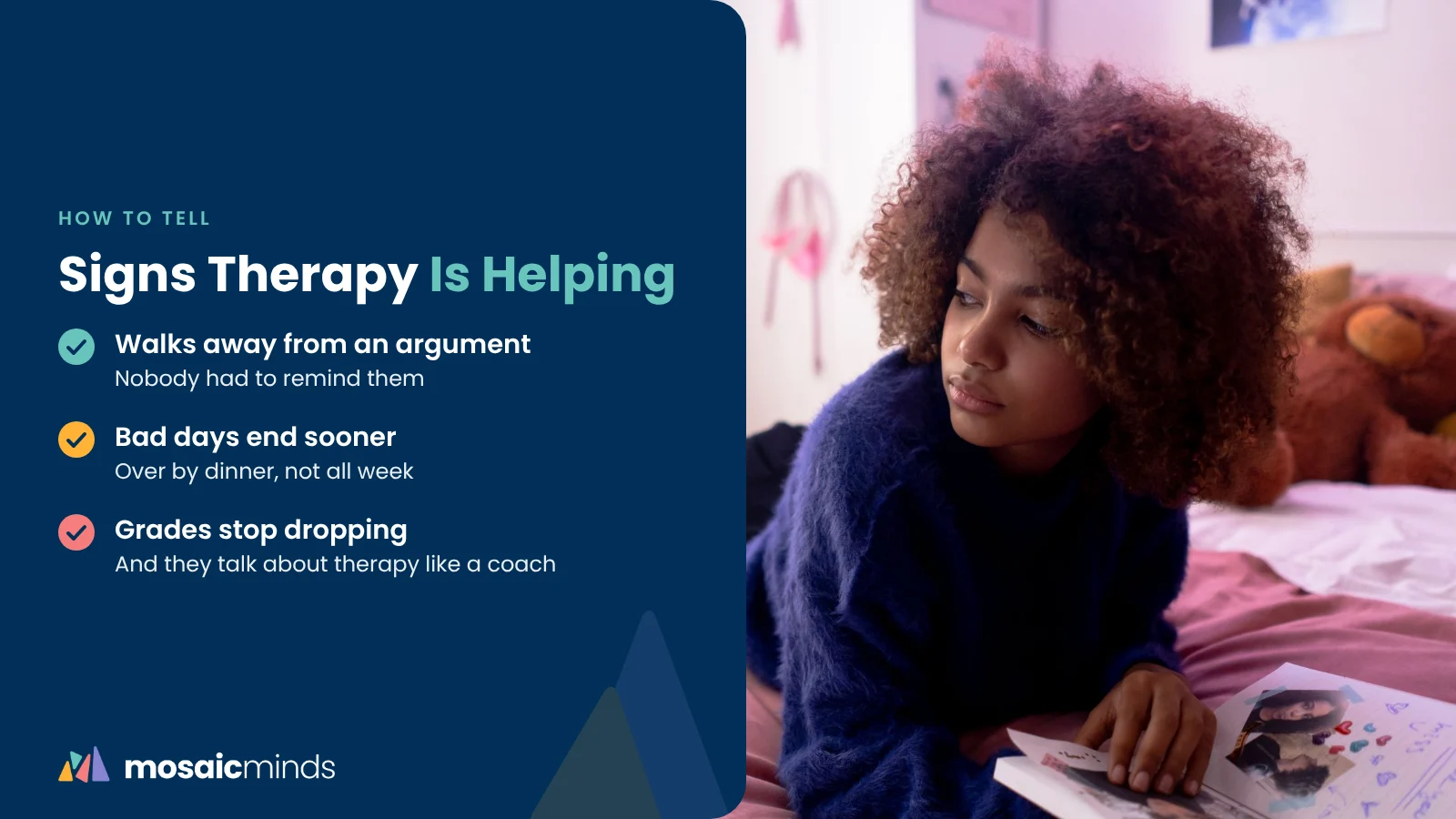
Your teen walks away from an argument before it blows up, and nobody had to remind them.
Bad days happen, but they’re over by dinner instead of lasting all week.
Grades stop dropping.
They mention their therapist the way they’d mention a coach.
If nothing’s changed after a fair shot, speak up. A good therapist will rethink the plan, add family sessions or talk about more support.
Need more support than a weekly session? See how our intensive outpatient program (IOP) adds structure while your teen keeps living at home.
Teen Therapy in Chandler, AZ, Built Around Your Teen
At Mosaic Minds, we offer teen therapy in Chandler, AZ for ages 11 to 17. Our programs use skills-based approaches like CBT and DBT, with school support and family involvement built in. Our IOP and partial hospitalization program (PHP) give teens more support than weekly sessions while they live at home.
That depends on what your teen is dealing with. AACAP notes that cognitive behavioral therapy has research support for depression and anxiety in kids and teens. When family conflict is a big piece, family therapy helps, and some programs add skills for handling intense emotions. An assessment is the best way to sort out the mix.
What if my teen says therapy isn't helping?
Take it seriously, but ask what they mean. Sometimes it is the therapist, sometimes the timing, and sometimes therapy just feels uncomfortable before it starts to help. Share the feedback with the therapist. If the fit is wrong, switching to someone new is fine and often makes a real difference.
Is therapy worth it if my teen won't talk?
Usually, yes. A quiet teen in session one is normal. Plenty of therapists start with art, games or short check-ins until a teen feels ready to say more. Give it some time. If several weeks pass with no change at all, ask the therapist whether another approach could work better.
Does teen therapy work without parents involved?
It can work, though having you involved tends to help. Your teen is trying new skills at home, so knowing what they’re working on lets you support it rather than undercut it by accident. You don’t need to be in the room. An occasional check-in with the therapist is usually enough.
Katie Crosby is a Licensed Master Social Worker (LMSW) and Primary Therapist at Mosaic Minds, with experience providing therapy to adolescents and families. She takes a holistic, strengths-based approach that focuses on each person’s unique abilities and resilience. Her goal is to create a safe, supportive environment where people feel heard, empowered and confident as they navigate challenges and grow.
Help for troubled teens usually starts closer to home than parents expect. Begin with your teen’s doctor or school counselor, then get a mental health evaluation if the problems keep going. From there, most teens do best with outpatient therapy or a day program near home, not a boot camp hundreds of miles away.
Key takeaways
“Troubled” behavior is often a sign of something underneath, like anxiety, depression or stress at school.
Start with your teen’s doctor or a licensed mental health professional, not a program ad.
Most teens can get the help they need while living at home.
Be wary of any program that limits family contact or can’t show a license.
Lots of parents are in the same spot right now. In CDC’s 2025 Youth Risk Behavior Survey, roughly one in three high schoolers said they felt sad or hopeless for weeks at a time, yet fewer than a third of those teens had seen a counselor or therapist in the past year.
When Does Teen Behavior Need Professional Help?
Teen behavior needs professional help when it lasts for weeks, keeps getting worse, or starts to wreck school, friendships or home life. Eye rolls and slammed doors are part of being a teenager. Skipping school, constant fighting, pulling away from everyone, or talking about feeling hopeless are signs to get an evaluation.
1 in 3
High school students who felt persistently sad or hopeless
The word troubled gets used a lot, but most of these teens are struggling, they are not bad. Anxiety can look like defiance. Depression can look like laziness. Our guide on how mental health affects teens explains how that shows up at school and at home, and we also break down normal moodiness versus real red flags.
Where Should Parents Start?
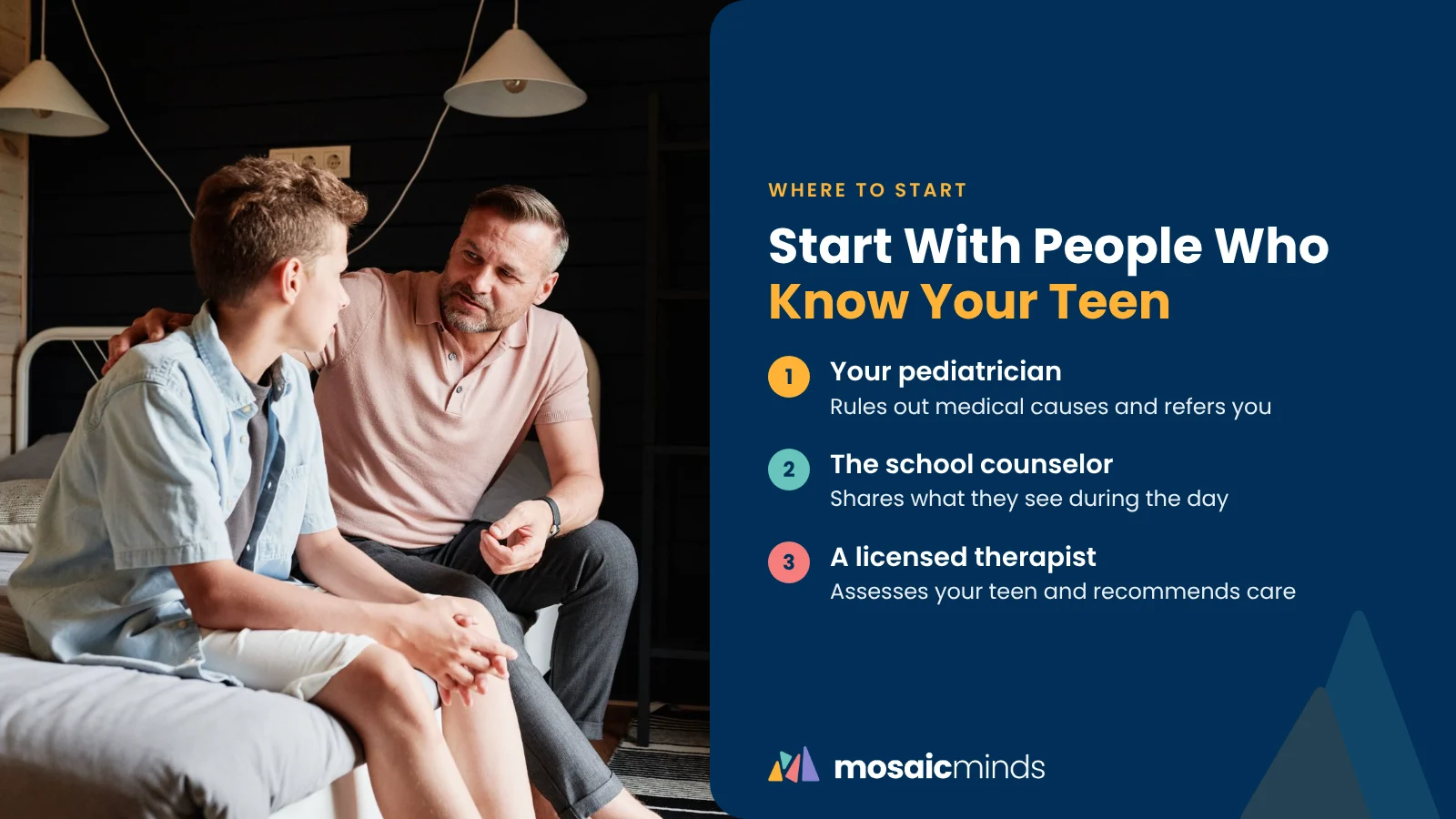
Start with the people who already know your teen. Your pediatrician can rule out medical causes and refer you for an evaluation. Your teen’s school counselor can tell you what they see during the day. A licensed therapist or adolescent program can then assess your teen and recommend a level of care.
In practice, it often goes like this:
Talk with your teen calmly about what you have noticed, without a lecture.
Book a visit with their pediatrician and bring specific examples.
Check in with the school counselor about grades, attendance and friendships.
Schedule a mental health evaluation with a licensed professional.
Choose the least intensive level of care that keeps your teen safe and making progress.
What Kinds of Help Are There for Troubled Teens?
Help for troubled teens ranges from weekly therapy to full-time residential care. Most teens start with outpatient therapy. When that isn’t enough, an intensive outpatient program (IOP) or partial hospitalization program (PHP) adds more hours of treatment while your teen keeps living at home and stays connected to school.
Level of care
What it involves
Often a fit when
Weekly therapy
One session a week with a therapist
Problems are real, but your teen is mostly managing day to day
Intensive outpatient (IOP)
Several hours of therapy and skills work each week, home every night
Weekly sessions aren't enough on their own
Partial hospitalization (PHP)
A structured treatment day, home at night
Your teen needs daily support but is safe at home
Residential treatment
Living at a supervised facility for a period of time
Outpatient care hasn't helped, or home is not safe right now
AACAP describes residential care as an option for teens who haven’t improved with outpatient treatment or whose health is at risk in their community. For most families, it is not the first step.
Are Boot Camps and Wilderness Programs Safe?
Some may be, but it is hard to tell from a website. A federal GAO investigation found thousands of abuse allegations at residential programs for teens between 1990 and 2007, and reported that no federal law defines or regulates them. State oversight ranged from licensing to nothing at all.
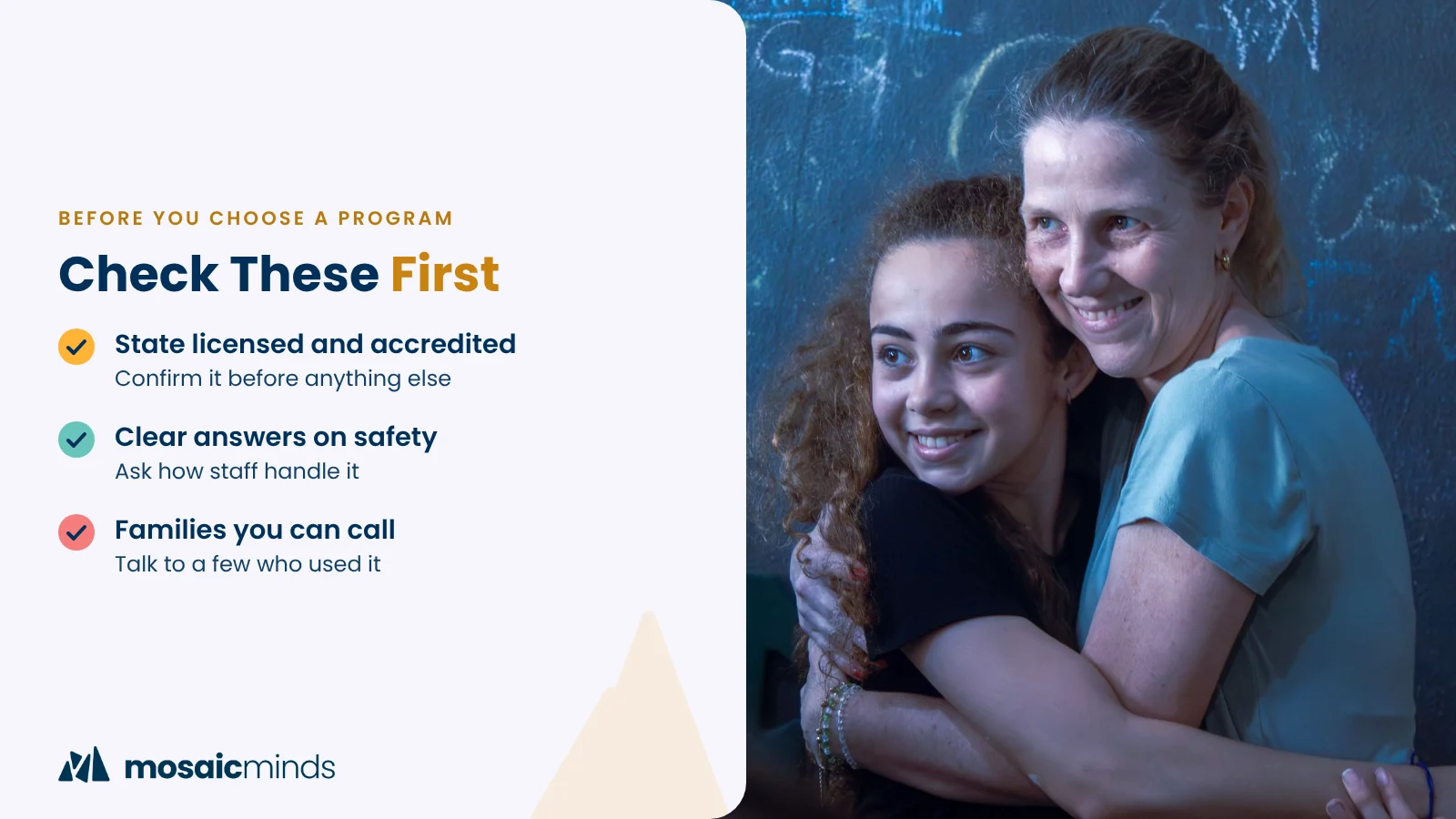
A residential program might come up as an option, especially if things are really bad. AACAP recommends checking that it’s state licensed and accredited, asking how staff handle safety, and calling a few families who’ve used it. A program that restricts phone calls home, or gets vague about its therapy, is a red flag.
While you’re waiting on an appointment, home just needs to be steady enough. For most families that means bedtimes and dinner stay put, a couple of rules stay firm, and everything else gets dropped for now. Don’t push for big talks. Some of the best talks with teens happen in the car.
At Mosaic Minds, our teen therapy in Chandler, AZ is built for teens 11 to 17 who need more than weekly sessions. Our IOP and PHP let your teen live at home and stay connected to school, with family involvement throughout. Every family starts with a free consultation and an assessment.
What do you do when your teenager is out of control?
Calm things down first. Lower your voice, walk away from the argument if you need to, and stick to one or two limits you can actually enforce. Later, when everyone has cooled off, set up an evaluation. Behavior that feels out of control usually has something under it, like anxiety, depression or trouble at school.
What is the best therapy for troubled teens?
That depends on what’s going on underneath. Cognitive behavioral therapy has strong research for teen anxiety and depression. If most of the trouble shows up as fighting at home, family therapy may do more. An evaluation sorts this out so you’re not guessing, and the plan can change as your teen does.
Can I make my teenager go to therapy?
You can usually get your teen to an appointment, but you can’t make them talk. Explain why you are worried, give them some say in the details, like the time or the therapist, and expect a rocky start. Many teens warm up once they figure out the therapist is on their side.
Is it normal for teens to be angry all the time?
Some irritability comes with being a teenager. Anger that lasts for weeks, gets physical, or shows up with other changes, like poor sleep or falling grades, is different. In teens, depression and anxiety often look like anger rather than sadness, so constant anger is worth having checked by a professional.
Katie Crosby is a Licensed Master Social Worker (LMSW) and Primary Therapist at Mosaic Minds, with experience providing therapy to adolescents and families. She takes a holistic, strengths-based approach that focuses on each person’s unique abilities and resilience. Her goal is to create a safe, supportive environment where people feel heard, empowered and confident as they navigate challenges and grow.
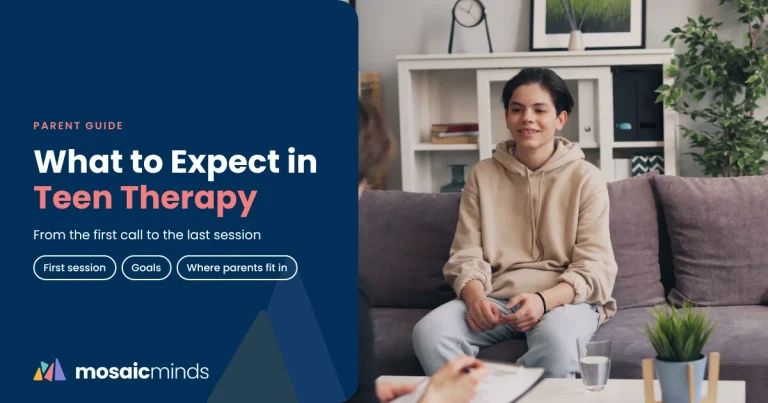
What to expect in teen therapy comes down to a few stages: a phone call and screening, an assessment, a first session that is mostly getting to know each other, then regular work on a few clear goals. Your teen does most of the talking. You stay in the loop, just not in every conversation.
Key takeaways
There’s a call, a screening and an assessment before the first real session.
Session one is mostly small talk, and that’s on purpose.
After that, therapy follows two or three goals you set together.
Most teens taper off gradually instead of stopping cold.
Knowing the order ahead of time takes some of the fear out of it, for you and for your teen. It also makes it easier to tell whether a program is a good fit.
What Happens Before the First Session?
It starts with a phone call, usually from you, not your teen. You explain what’s been going on and answer basic questions about age, school, insurance and safety. Here at Mosaic Minds, that call leads to a free 15 to 30 minute consultation, then an assessment so we can suggest the right level of care.
You can handle most of this on your own. Before you call, jot down when things started to change, what you’ve tried so far, and what a rough day at home actually looks like. That gives the team plenty to work with. Our page on how admissions works lays out each step.
What Happens in the First Teen Therapy Session?
The first teen therapy session is mostly about getting to know each other. The therapist asks about school, friends, family, sleep and what feels hard right now. Parents often join for part of it and then step out, so your teen gets time to talk alone. Nobody expects a breakthrough on day one.
Your teen might shrug through half the questions. That is fine. A good therapist won’t push, and may spend a while on music, a video game or the family dog. It sounds small, but that is how trust gets built.
Early on, the therapist will also explain privacy: what stays between them and your teen, and what would come to you. We cover that in more detail in our guide to what teen therapy looks like in Chandler.
What Does Teen Therapy Look Like After the First Few Weeks?
Once the getting-to-know-you phase is over, sessions get more focused. You and the therapist agree on two or three goals, like fewer meltdowns before school or a bedtime that sticks. Your teen learns a skill, tries it at home, and comes back to talk about what happened. If something isn’t working, the plan changes.
63%
Chance a young person in therapy does better than one who did not get it
A lot of teen programs teach practical skills. Per AACAP, cognitive behavioral therapy (CBT) has research behind it for depression and anxiety in kids and teens. The short version: your teen learns to catch the thoughts that spiral, then tries out a different response, again and again, until it gets easier.
Stage
What usually happens
Where parents fit in
First call
Intake questions, a safety screening, insurance details
Share what you have noticed at home
Assessment
A closer look at needs and the right level of care
Fill in history and ask questions
First session
Getting to know your teen, explaining privacy
Join for part of it, then step back
The weeks after
Goals, skills practice, progress check-ins
Support practice at home
Wrapping up
Sessions spaced out, a plan for setbacks
Watch for changes and keep talking
Not every family moves through these stages at the same pace. Some teens need more support up front, which is where an intensive program comes in.
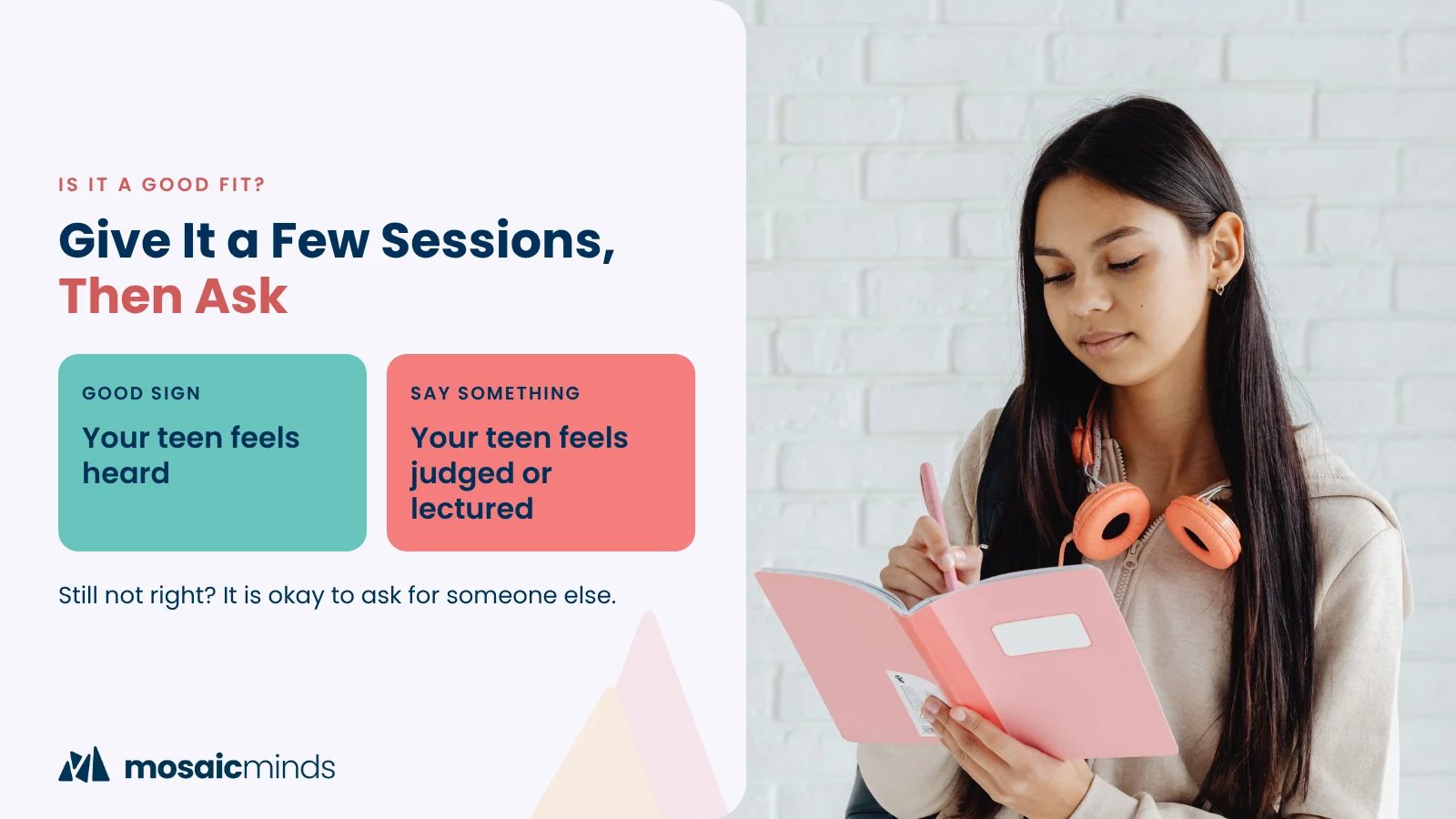
If your teen walks out of the first session saying they hated it, don’t panic. Plenty do. Ask what felt off: the therapist, the questions, or just being there at all. Give it a few sessions before deciding, and if the fit still feels wrong, it is okay to ask for someone else.
Fit is a big deal. If your teen feels heard, that’s a good sign. If they feel judged or lectured, say something.
How Do Parents Fit Into Teen Therapy?
You’re involved, but you won’t be in the room every week. Expect check-ins every so often, updates on how things are going, and maybe some coaching on what to say when tempers flare at home. How much the therapist tells you depends on your teen’s age and on what everyone agreed to at the beginning.
Between sessions, play it cool. Ask how it went one time, and if the answer is “fine,” let it be fine. Your teen might bring it up later, or not at all, and both are okay. If fights at home keep coming up, family therapy for teens can happen alongside your teen’s own sessions.
How Does Teen Therapy End?
Most teens don’t just stop therapy one week. As they hit their goals, sessions spread out, or they move from an intensive program down to weekly visits. Toward the end, the focus shifts to what to do if things get hard again, so your teen walks away with a plan they actually believe in.
Ending well matters as much as starting well. Ask the therapist what progress looks like for your teen, so you both know when it is time.
Teen Therapy in Chandler, AZ at Mosaic Minds
At Mosaic Minds, we offer teen therapy in Chandler, AZ for ages 11 to 17. Every family starts the same way: a call, a free consultation, an assessment and a recommendation. From there, your teen might join our IOP or PHP, with family involvement built into both.
Still on the fence? Send us a message or call 480-916-9600. It’s just a conversation. We’ll tell you straight what we think your teen needs, even if that’s not us.
It depends on the level of care. Many teens start with one session a week. Teens who need more support might attend an intensive outpatient program several days a week, or a partial hospitalization program with a full structured day. The therapist recommends a starting point, and it can change as your teen improves.
Do parents sit in on teen therapy sessions?
Sometimes. Many therapists bring you in at the start and for check-ins, but most of the hour is your teen’s. That alone time matters. Teens tend to say a lot more when mom or dad isn’t sitting next to them. If home life is part of the problem, family sessions are a separate option.
What should my teen talk about in the first session?
Whatever feels easiest. Your teen doesn’t need a speech or a list of problems. Talking about school, friends or what a normal week looks like is plenty to start. If they feel stuck, it is fine to say so out loud. Therapists are used to quiet first sessions and know how to work with them.
How do you know when teen therapy is done?
Therapy is usually done when your teen has met the goals you set together and can handle setbacks with the skills they learned. Most therapists taper sessions first instead of stopping all at once. Ask early on what finishing would look like for your teen, so the end does not come as a surprise.
Katie Crosby is a Licensed Master Social Worker (LMSW) and Primary Therapist at Mosaic Minds, with experience providing therapy to adolescents and families. She takes a holistic, strengths-based approach that focuses on each person’s unique abilities and resilience. Her goal is to create a safe, supportive environment where people feel heard, empowered and confident as they navigate challenges and grow.
If you’re asking, “How can I help my teenager with depression?” you have probably noticed a change. Maybe your teen has stopped talking, lost interest in favorite activities, or started getting upset over small things.
You want to help, but you may not know what to say or what to do next.
Start with a few simple steps:
Listen without trying to fix everything. Let your teen know you are there, even when they don’t want to talk.
Keep routines predictable. Regular meals, sleep, and manageable daily expectations can provide stability.
Look for ongoing changes. If signs of depression last two weeks or longer, contact your teen’s doctor or a qualified mental health professional. Seek help sooner if symptoms are severe or you are worried about their safety.
Remember that support can help. Depression is treatable, and your teen does not have to figure everything out alone.
You are not alone in this. According to the National Institute of Mental Health, 20.1% of U.S. adolescents ages 12–17 experienced a major depressive episode in 2021. Of those adolescents, 40.6% received treatment.
Reaching out for help is not overreacting. It is a way to show your teen that their well-being matters.
Signs of Depression in Teenagers
Depression does not always look like sadness. Some teens become quiet and withdrawn. Others seem angry, frustrated, or unusually distant.
Watch for changes that persist or begin affecting everyday life, such as:
Pulling away from friends, family, or favorite activities.
Sleeping much more or less than usual.
Losing interest in hobbies they once enjoyed.
Falling grades, missed assignments, or frequent school absences.
Low energy or difficulty starting everyday tasks.
Increased irritability or emotional outbursts.
Talking about feeling worthless, hopeless, or like a burden.
One sign alone does not necessarily mean your teen is depressed. What matters is the pattern, how long it lasts, and how much it affects their life.
Some of these changes overlap with other red flags in teenage behavior, so pay attention to how long they last and how much they disrupt school, sleep, and relationships.
How to Talk to a Depressed Teenager
Knowing how to talk to a depressed teenager can be difficult.
You don’t need a perfect speech. Start with a calm conversation when neither of you feels rushed. A walk or car ride may feel more comfortable than sitting face-to-face.
Instead of saying
Try saying
“Just cheer up.”
“I’m here for you, even when things feel hard.”
“What do you have to be depressed about?”
“I’ve noticed you’ve seemed down lately. Want to tell me about it?”
“You’re just being lazy.”
“It seems like everyday things have been taking a lot of effort.”
“When I was your age…”
“Tell me more about what this feels like for you.”
Asking question after question
“You don’t have to talk right now. We can try again later.”
Immediately offering solutions
“Would you like me to listen, or would you like help figuring something out?”
If your teen opens up, try to stay calm, even if what they share is difficult to hear. Thank them for trusting you.
If you are worried about their safety, ask calmly and directly whether they have thought about hurting themselves or ending their life. Asking about suicide does not put the idea in their head, and it gives your teen an opening to tell you what is really happening.
If they are not ready to talk, don’t force the conversation. Let them know you will check in again.
Discipline, Phones and School: Parenting a Depressed Teen
When a teen is struggling, everyday parenting decisions can become harder. Rules still matter, but your approach may need to change.
Discipline
Depression can affect energy, concentration, motivation, and daily responsibilities. What looks like defiance may sometimes be a sign that your teen is struggling.
Try to:
Keep a few clear, reasonable household rules.
Break chores and responsibilities into smaller steps.
Use calm, predictable consequences when needed.
Recognize effort, even when progress is slow.
Avoid long lectures, humiliation, or harsh punishment.
You can show understanding without removing every expectation. The goal is to help your teen manage responsibilities while feeling supported.
Phones and screen time
Taking a phone away in anger may increase conflict, especially if your teen relies on it to stay connected with friends.
Instead, agree on boundaries together. For example, you might charge phones outside the bedroom at night to protect sleep.
Ask about their online experiences without immediately criticizing them.
School
Depression can make school feel overwhelming. Missed assignments and absences may quickly build into more stress.
Contact the school counselor early. Together you can plan for missed work, adjust deadlines, and decide whether formal supports, such as a 504 plan, would help while your teen recovers.
Focus on manageable steps rather than expecting everything to return to normal overnight.
Family relationships can also affect how a teen feels. Family support can help parents learn how to respond to their teen’s needs. If divorce or separation is part of your family’s experience, helping teenagers cope with divorce starts with making space for their feelings without asking them to take sides.
Depression in Teens With ADHD or Autism
Depression can be harder to recognize in teens with ADHD or autism because some signs may overlap with other challenges.
For example, a teen may come home exhausted after managing noise, social expectations, transitions, and schoolwork all day. They may shut down, become more irritable, or need extra time alone.
These changes do not automatically mean depression. However, a noticeable change from your teen’s usual behavior deserves attention.
You can help by:
Asking what feels difficult instead of assuming your teen is being uncooperative.
Providing quiet time after demanding school days.
Reducing unnecessary sensory and social pressure.
Noticing changes in sleep, interests, mood, or daily functioning.
Finding support that respects how your teen communicates and experiences the world.
At Mosaic Minds, our neurodivergent-affirming support takes into account differences in communication, sensory needs, and everyday experiences.
The goal is not to change who your teen is. It is to understand what they need and help them feel supported.
What to Do If Your Teen Refuses Help
When a depressed teenager refuses help, you may feel frustrated, scared, or unsure what to do next.
Your teen may worry about being judged, feel embarrassed, or believe that nothing will make a difference. Instead of turning the conversation into a battle, try these steps.
Stay calm and keep the door open.
Describe what you’ve noticed.
Offer choices.
Start with a smaller step. A conversation with their pediatrician or school counselor may feel less intimidating than starting therapy.
Explain your reasons. Make it clear that getting support is not a punishment or a sign that something is wrong with who they are.
Try again later. A refusal today does not mean your teen will always refuse. Give them some space and revisit the conversation.
Get support for yourself.
You can seek professional guidance even if your teen is not ready to participate. You do not need to wait until things become worse to ask what options are available.
What if my teen is in crisis?
If your teen talks about suicide, threatens to hurt themselves, or you believe they may be in immediate danger, take the situation seriously.
Stay with your teen if it is safe to do so, and reduce access to items they could use to hurt themselves. If you are unsure how serious the situation is, seek professional guidance rather than waiting for symptoms to pass.
Teen Depression Support and Teen Therapy in Chandler, AZ
You do not have to navigate this situation alone. Sometimes, listening and making changes at home are not enough.
Mosaic Minds supports teens ages 11–17 in Chandler, Arizona. Our approach is individualized and neurodivergent-affirming, with family involvement throughout the process.
Some teens need more support than weekly sessions can provide. Mosaic Minds offers two structured program options:
Intensive Outpatient Program(IOP): Provides additional support and structure while helping teens stay connected to home, school, and daily life.
The right option depends on your teen’s individual needs. Mosaic Minds offers an initial consultation and assessment process to help families understand their options.
Teen Depression FAQs
What are the common causes of depression in teenagers?
There is rarely one single cause. Family history, ongoing stress, bullying, loneliness, difficult life changes, and school pressures may all play a role. Biological factors can also contribute. Every teen’s experience is different.
How do teens cope with depression?
Teens may benefit from talking to a trusted adult, spending time with supportive friends, maintaining regular sleep and meal routines, and taking small steps toward activities they enjoy. Professional support can help when depression affects everyday life.
Is it OK to take away a depressed teen’s phone?
It depends on the situation. Taking a phone away as an angry punishment can increase conflict and cut off an important source of social connection. Instead, agree on reasonable boundaries together, such as charging the phone outside the bedroom at night, so sleep is protected without cutting your teen off from supportive friends.
How do you discipline a depressed teen?
Keep expectations clear, calm, and manageable. Break tasks into smaller steps and acknowledge effort rather than focusing only on what your teen has not done. Depression can make everyday responsibilities feel harder, but that does not mean every behavior should be ignored.
Family therapy for teens often does help, especially when the trouble at home isn’t only your teen’s. Maybe the same argument plays out every night. Maybe your teen barely tells you anything anymore. A family therapist works on those patterns with all of you and doesn’t pick sides.
A 2015 review of family interventions, hosted by the American Academy of Child and Adolescent Psychiatry (AACAP), found support for family-based treatment in teen depression, substance use, behavior problems and eating disorders.
Key takeaways
Your teen isn’t the patient here; the family is.
Repeat fights or a teen who’s gone silent are common reasons to start.
A teen who won’t come can see a therapist solo first.
Family and individual therapy can run at the same time.
What Is Family Therapy for Teens?
In family therapy for teens, the client is really the household. AACAP defines it as therapy that helps a family work together in healthier ways. Your teen and parents usually attend, and siblings or grandparents sometimes join, depending on what’s going on and what the therapist thinks will help.
The therapist watches your teen, sure, but also what happens between all of you. Maybe every homework question ends in yelling. Maybe one parent goes quiet while the other lectures. Family counseling for teens helps you spot those loops and try a different move next time.
Signs Your Family Could Benefit From Family Therapy
A lot of parents wonder whether things are bad enough for therapy. They don’t have to be. If home has felt tense for a while, or your teen has gone quiet and you can’t get through, that’s reason enough to ask a therapist. These come up a lot:
Small talks turn into big arguments.
Your teen won’t talk about how they feel.
Rules and curfews start the same fights.
Trust got broken and is hard to rebuild.
You and your co-parent disagree on how to handle things.
Stress at home is affecting sleep, school, or routines.
None of this means you’ve failed as a parent. It usually means the old approach stopped working. Big changes like a separation can set these patterns off, too, and our guide on helping teenagers cope with divorce goes deeper on that.
What Happens in a Family Therapy Session?
The first session is mostly the therapist listening. They’ll ask what’s been happening at home, how each of you sees it and what you’d like to be different. Expect everyone to get a turn. That matters, because teens often walk in assuming they’ll be the one blamed.
After that, sessions usually move through a few kinds of work:
Understanding the concerns: Discuss what has been happening at home.
Identifying patterns: Explore how family members respond to one another during conflict.
Practicing new skills: Learn ways to listen, communicate, and set boundaries.
Setting goals: Choose realistic changes to practice between sessions.
How fast that happens depends on the therapist and on your family.
Not sure how to get started? See how admissions at Mosaic Minds works, from the first phone call to the first session.
What If Your Teen Doesn’t Want to Go?
Expect some pushback. Teens tend to picture three adults teaming up on them, or being pushed to talk about stuff they’re not ready to touch.
Before the first appointment, have a short, low-key talk. Something like: home has felt hard lately, we’re getting some help with that, and you’re not in trouble. Let them grumble. Let them ask questions. If they’ll only agree to see someone alone at first, take that win.
Which Types of Family Therapy Have the Strongest Evidence?
For teens, the best-studied options are attachment-based family therapy for depression, family-based treatment for anorexia and multidimensional family therapy for substance use, according to the AACAP-hosted review. For serious behavior problems, functional family therapy and multisystemic therapy have the strongest track record.
Approach
Teen concern it has been studied for
Attachment-based family therapy
Depression and suicidal thoughts
Family-based treatment (FBT)
Anorexia nervosa
Multidimensional family therapy
Substance use
Functional family therapy and multisystemic therapy
Delinquency and behavior problems
Family-focused treatment
Bipolar disorder
A caveat: a lot of these studies were small, and researchers still can’t say which method suits which family best. That’s a conversation to have with a therapist. If low mood is the main concern, our guide on helping a teenager with depression covers what to say and when to get an evaluation.
Family Therapy vs. Individual Therapy for Teens
Individual therapy is your teen’s space to work on their own thoughts, feelings and coping skills. Family therapy works on how all of you talk and handle conflict. Neither one wins outright. Lots of teens do both, and a therapist can help you decide which to start with.
Individual Teen Therapy
Family Therapy
Focuses on the teen’s feelings, thoughts, and goals
Focuses on relationships and patterns within the family
Gives the teen space to discuss personal concerns
Helps family members practice communication and problem-solving
Supports personal coping skills
Supports healthier interactions at home
They tend to feed each other. Your teen practices a coping skill one-on-one, and at home you learn how to respond when they use it.
How We Involve Families in Teen Therapy in Chandler, AZ
At Mosaic Minds, we work with teens ages 11 to 17, and family involvement is built into our teen therapy in Chandler, AZ. Through our family support services, parents get regular updates on how their teen is doing, plus practical guidance for home.
Four names come up most: structural, strategic, systemic and functional. Structural looks at roles and boundaries. Strategic zeroes in on one specific problem. Systemic steps back to see bigger family patterns, and functional works on communication and behavior. Most therapists don’t stick rigidly to one; they pull from several depending on your teen.
What kind of therapy is best for teens?
It depends on what your teen is dealing with. For anxiety and depression, cognitive behavioral therapy (CBT) has a lot of research behind it. When home life is part of the problem, family therapy earns its place, and plenty of teens do both. A clinician’s assessment is how you find the right combination for your kid.
Is family therapy the same as family counseling?
Pretty much. You’ll hear both terms used for the same thing: a family sitting down with a mental health professional to talk better and sort out conflict. Don’t get hung up on the label. What you want to know is how the therapist was trained and whether they’ve worked with teens before.
Can parents go to family therapy without their teen?
Yes. Plenty of therapists start with parents alone, especially when a teen isn’t ready. Those sessions can help you understand what your teen is dealing with, change how you react in tense moments and plan how to bring them in later. Often the teen joins once things at home feel a little safer.
Helping teenagers cope with divorce starts with two things: keeping adult conflict away from them and being honest about what is changing. Teens do not need a perfect separation. They need to know the people they rely on are still steady.
If your teen is between 11 and 17, they may understand more about divorce than a younger child, but that does not mean they know how to process it. Teens may ask difficult questions, become angry, withdraw, or act as if nothing has changed.
Key Takeaways
Keep conflict away from your teen.
Tell them what is happening honestly.
Protect their routines.
Never use them as a messenger.
Watch for changes that last or interfere with daily life.
How Divorce Affects Teenagers
How divorce affects teenagers varies from one teen to another. Some may feel sad or angry. Others may seem relieved, quiet, or completely fine.
The American Academy of Child and Adolescent Psychiatry notes that children may feel sadness, anger, guilt, and worry about the future. Older children and teens may also experience school difficulties, behavior changes, or problems with relationships.
Teens are also developing independence and identity. Divorce can disrupt routines, living arrangements, family traditions, and their sense of what comes next.
Your teen does not need you to explain away every difficult feeling. They need space to react and parents who remain steady.
Talking works best when your teen feels heard rather than corrected, which is why a safe space for conversations at home matters so much right now.
How to Tell Your Teenager About Divorce
Knowing how to tell a teenager about divorce can make the conversation feel less overwhelming. When possible, both parents should prepare the message together.
Agree on the basic message. Keep the explanation short, factual, and appropriate for your teen’s age.
Tell them together, if possible. This can help your teen understand that both parents are still focused on their well-being.
Choose a calm time. Avoid school mornings, major exams, or moments when you have to leave immediately afterward.
Be honest without oversharing. Explain what is changing without sharing adult relationship details or assigning blame.
Say clearly that it is not their fault. Teens may wonder whether something they did caused the separation.
Explain what will stay the same. Talk about school, activities, friends, routines, and other parts of daily life.
Let them react. Anger, silence, sadness, questions, or no visible reaction can all happen.
Keep talking. One conversation is rarely enough. Your teen may need time before they know what they want to ask.
The AACAP recommends telling children together when possible, keeping explanations straightforward, reassuring them that the divorce is not their fault, and avoiding discussions about each parent’s faults.
For a neurodivergent teen, changes in routine may feel especially difficult. Give them extra processing time and provide plans in writing if that makes information easier to manage.
What Your Teen Says vs. What It May Mean
A teen’s words do not always explain what they are feeling. Look for patterns rather than trying to interpret one comment on its own.
What your teen says
What it may mean
What can help
“I don’t care.”
Hurt or overwhelm they cannot explain yet.
Stay calm and let them know you are available.
“Whatever, do what you want.”
They may feel powerless over the changes.
Offer choices about things they can control.
“Which one of you is moving out?”
They want concrete information and predictability.
Give clear answers about upcoming changes.
“I’m fine.”
They may not be ready to talk or may be protecting you.
Check in again later without pushing.
“I hate you both.”
Anger about a situation they cannot control.
Acknowledge the anger without taking it personally.
“Can I stay at my friend’s?”
Home may feel tense, and they may want space.
Reduce conflict at home while maintaining connection.
One comment does not tell you everything. Patterns over time matter more.
Co-Parenting a Teenager: 5 Mistakes to Avoid
Co-parenting a teenager means keeping the basics consistent while allowing your teen to maintain a relationship with both parents. The American Academy of Pediatrics recommends avoiding situations that put children in the middle of parental conflict.
Using your teen as a messenger. Communicate directly with the other parent instead of saying, “Tell your dad…”
Speaking badly about the other parent. Your teen should not feel responsible for choosing sides.
Treating your teen like an emotional support person. Share adult concerns with another adult, not your child.
Changing every rule between homes. Try to keep important expectations around school, curfews, and responsibilities reasonably consistent.
Ignoring your teen’s schedule. Jobs, sports, friendships, and activities are important parts of adolescence.
Neither parent has to handle every moment perfectly. Saying, “I handled that badly,” can show your teen that adults can acknowledge mistakes and repair relationships.
When to Get Help for a Teen Struggling With Divorce
Sadness, frustration, and irritability can be part of adjusting to a major family change. Consider professional support when changes persist, become more intense, or begin interfering with daily life.
You may want to reach out if your teen:
Withdraws from friends, family, or activities they previously enjoyed
Has ongoing changes in sleep, appetite, or energy
Stops attending school or experiences a significant drop in grades
Has frequent anger, panic, or tearfulness
Talks about feeling hopeless or worthless
Shows risky behavior or self-harm
Knowing the common red flags in teenage behavior can help you tell the difference between a hard adjustment and something that needs more attention.
Family therapy can provide a space for family members to improve communication and work through changes together. Mosaic Minds also provides support for teens experiencing depression. When sadness lingers, it helps to know how to help your teenager with depression before it starts affecting school, sleep, and friendships.
Teen Therapy in Chandler, AZ for Families in Transition
Helping teenagers cope with divorce does not always mean therapy is necessary. Our guide to family therapy for teens explains when it can help. But if the transition is contributing to broader emotional, behavioral, school, or daily-life challenges, professional support may be worth exploring.
Mosaic Minds offers teen therapy in Chandler, AZ for adolescents ages 11 to 17. Its IOP and PHP programs provide more structure than weekly therapy when a teen needs additional support. Families remain involved throughout the process.
The right level of support depends on your teen’s current needs and daily functioning.
Teens and Divorce FAQs
What age is divorce most damaging to a child?
There is no single age when divorce is automatically most damaging. Children and teens can respond differently depending on their developmental stage, family circumstances, level of conflict, and available support. What matters is helping the teen feel safe, supported, and connected to both parents when appropriate.
How do I help my teenage son through our divorce?
Keep conversations low-pressure. Some teens open up more while driving, walking, cooking, or doing another activity rather than sitting down for a serious conversation. Keep routines consistent, avoid putting him between parents, and let him know he can talk without being judged.
How long does it take teens to adjust to divorce?
There is no set timeline. A teen may adjust to new routines over time, but difficult feelings can return around holidays, school changes, birthdays, or other family transitions. If your teen’s struggles are getting worse or interfering with daily life, consider professional support.
What should teens expect when their parents divorce?
They can expect some changes, but parents can make those changes easier to understand. Explain where they will live, how routines may work, and what will stay the same. Let your teen know that mixed feelings such as sadness, anger, relief, or confusion can happen.
Helping teenagers cope with divorce takes time. Your teen does not need perfect parents or a perfect transition. They need honesty, stability, room to have feelings, and support when those feelings become difficult to manage.
Signs of trauma in teens can include withdrawal, anxiety, anger, sleep problems, difficulty concentrating, avoiding reminders of an upsetting event, changes at school, or risky behavior.
If you are wondering what the signs of trauma in teens are, look for changes that are new, persistent, or affecting everyday life. Parents looking for teen therapy in Chandler can start by understanding what might be happening, what signs to watch for, when to seek professional help, and what types of support may be available.
What Might Be Happening With Your Teen?
A difficult or frightening experience can affect how a teenager behaves, communicates, sleeps, and manages everyday responsibilities. Teens do not all respond to stressful experiences in the same way, and a reaction to trauma does not automatically mean a teen has PTSD (Post-traumatic stress disorder).
The National Center for PTSD notes that teens may experience anger, avoidance, sleep problems, difficulty concentrating, withdrawal, or changes in school and relationships following trauma. Some may also become more impulsive or engage in risky behavior.
SAMHSA also identifies withdrawal, aggression, self-harm, substance use, risky behavior, and difficulties with concentration or school performance as possible signs of traumatic stress in adolescents.
These changes can have many causes. The goal is not for parents to diagnose trauma, but to notice when their teen seems significantly different from usual.
What Signs Should I Watch For?
Knowing what signs of trauma in teens are can help parents recognize patterns without immediately labeling a behavior. One change alone may not mean much.
Several changes appearing together, especially after a distressing experience, may be a reason to check in with your teen or seek professional guidance.
Watch for:
Pulling away from friends, family, hobbies, sports, or activities they normally enjoy
Increased anger, irritability, anxiety, fear, or emotional overwhelm
Changes in sleep, nightmares, concentration, appetite, school performance, or daily routines
Avoiding people, places, conversations, or activities connected with what happened
Becoming unusually jumpy, withdrawn, impulsive, or difficult to engage
New risky or self-destructive behavior
Frequent physical complaints, such as headaches or stomachaches, without an obvious explanation
Parents should look at the overall pattern. A teenager having a difficult week is different from a noticeable change that continues and begins affecting school, relationships, home life, or normal routines.
How Can Trauma-Related Changes Affect Daily Life?
For some teens, changes are easiest to notice at home. A previously independent teenager may suddenly need more reassurance, while another may become quieter and spend much more time alone.
School can provide another clue. Difficulty concentrating, lower motivation, attendance problems, or changes in grades may accompany traumatic stress. SAMHSA identifies learning difficulties and changes in academic performance among possible effects associated with child traumatic stress.
Relationships may change too. A teen may avoid friends, become more irritable with family, or have difficulty trusting others.
Parents do not need to force a conversation about the event. Staying available, maintaining routines, and creating a supportive environment can give teens space to communicate when they are ready.
Families exploring teen mental health support can also consider whether their teen needs more structured support than weekly counseling.
When Should I Seek Professional Help?
Parents often wonder whether they should wait and see if things improve. There is no single timeline that applies to every teenager.
Professional guidance may be appropriate when changes persist, become harder to manage, or interfere with school, relationships, home life, or everyday routines. The National Center for PTSD recommends seeking professional help when symptoms are persistent, distressing, or interfere with daily functioning.
You also do not need to determine whether trauma is the cause before reaching out. A qualified professional can help families understand what may be contributing to the changes and what level of support could be appropriate.
What Type of Support Might Exist?
Not every teenager needs the same level of support. Some may benefit from traditional outpatient therapy, while others need additional structure when emotional, behavioral, school, or daily-life challenges become harder to manage.
This is where structured programs such as IOP and PHP may come into the conversation.
At Mosaic Minds, we provide teen mental health support in Chandler for adolescents ages 11 to 17. Its approach is neurodivergent-affirming, and its programs provide different levels of structure and support for teens and their families.
IOP and PHP at Mosaic Minds
The main difference between IOP and PHP is the level of structure and support. Mosaic Minds describes IOP as providing additional support while helping teens stay connected to daily life. PHP provides a higher level of structure and support throughout the week.
Feature
IOP
PHP
Level of support
Additional support and structure
More intensive structure and support
Daily life
Designed to support connection with everyday routines
Provides greater structure when daily functioning is more difficult
Focus
Skill building and support around everyday challenges
More consistent support for ongoing challenges
Family involvement
Part of the support process
Part of the support process
Program selection
Based on the teen’s needs and assessment
Based on the teen’s needs and assessment
Mosaic Minds also offers group therapy for teens and describes its care as neurodivergent-affirming. For parents, the goal is to find an environment that fits the teen rather than choosing a level of care based on one symptom.
Are You Looking for Teen Therapy in Chandler?
You don’t need all the answers before asking for help. If your teen’s behavior, school experience, relationships, or daily routines have changed, a conversation can help you understand what support may be appropriate.
Mosaic Minds provides structured support for teens ages 11 to 17 in Chandler, including IOP and PHP options and a neurodivergent-affirming approach.
Frequently Asked Questions
What are signs of trauma in teens?
Common signs can include withdrawal, anxiety, anger, sleep problems, difficulty concentrating, avoidance, changes in school performance, and risky behavior. Teens may also experience changes in relationships or daily routines. These signs can have many possible causes, so parents should look at the overall pattern and consider professional guidance when changes persist or interfere with everyday life.
How does trauma affect a teenager’s behavior?
Trauma can affect behavior in different ways. A teenager may become more withdrawn, irritable, aggressive, anxious, impulsive, or avoidant. Some teens may also experience changes in school performance, friendships, sleep, or daily routines. These behaviors do not automatically indicate trauma, which is why understanding the broader situation matters when deciding whether to seek support.
Can trauma symptoms appear months after an event?
Changes may not always be obvious immediately after a difficult experience. A teen may initially appear to be coping and later show changes in mood, behavior, sleep, relationships, or school functioning. Parents who notice new or persistent changes can speak with a qualified professional rather than trying to determine the cause on their own.
When should a teenager see a mental health professional after trauma?
Professional support may be appropriate when changes persist, become harder to manage, or interfere with school, relationships, routines, or everyday functioning. Parents do not need to know whether the cause is trauma before reaching out. A qualified professional can help determine what type of support may fit the teenager’s needs.
Parent and teenager communication improves when parents create low-pressure opportunities for teens to talk instead of pushing for immediate answers.
For families researching teen therapy options, communication changes can be an early sign that a teen needs additional support, especially when withdrawal begins affecting school, relationships, sleep, or daily life. Strong communication does not require a perfect relationship; it means creating enough safety and consistency for a teen to stay connected.
Why Parent and Teenager Communication Matters
Parent and teenager communication can influence how supported a teen feels when dealing with stress, conflict, school pressure, or emotional challenges. Research published in JCPP Advances found an association between parent-child communication and adolescent mental health, supporting the importance of communication when assessing and addressing young people’s emotional well-being.
For parents, this means focusing less on getting a teen to immediately open up and more on making communication feel safe enough to happen naturally.
Why teenagers may pull away
Adolescence involves major social, emotional, and cognitive changes. The National Institute of Mental Health explains that the brain continues developing throughout adolescence, including areas involved in planning, prioritizing, and decision-making.
Teens are also developing independence, navigating peer relationships, and managing new academic and social expectations. A teenager may therefore want more independence while still needing significant support with emotions, decisions, and communication.
When Communication Changes May Signal a Larger Problem
A quiet teenager is not automatically experiencing a mental health condition. Some withdrawal is part of adolescence. What matters is whether the change is persistent, significant, or accompanied by changes in everyday functioning.
The CDC recommends paying attention to changes in mood, behavior, relationships, school performance, sleep, and other aspects of daily life when considering whether a young person may need support.
Changes parents should watch for
Pulling away from family, friends, hobbies, or activities they previously enjoyed
Noticeable changes in sleep, appetite, energy, school performance, or concentration
One change does not explain what a teen is experiencing. A pattern that continues or interferes with daily life is useful information to bring to a pediatrician, therapist, or mental health professional.
Communication Strategies That Work at Home
Better parent and teenager communication does not require parents to find the perfect question. It often starts by lowering the pressure around the conversation.
Create opportunities instead of demanding disclosure
Some teens communicate more easily while doing something else. A car ride, walk, meal preparation, or shared activity can create space for conversation without making the teen feel like they are being interviewed.
The goal is not to force disclosure. It is to make connection available.
Listen before solving
When a teen shares something difficult, immediately offering advice can unintentionally end the conversation. Reflecting what you heard first can show that you understand their experience.
Try:
“That sounds really frustrating”
“You seem exhausted by everything happening at school”
“Do you want me to listen, or do you want help figuring out what to do?”
These responses do not solve the problem. They give the teen room to explain more.
Give reasonable choices
Teens can also benefit from having some control over how a conversation happens. Parents might ask whether they want to talk now or later, whether they would rather talk while walking or sitting, or whether they want advice or simply someone to listen.
This can be especially helpful for neurodivergent teens whose communication preferences, sensory needs, or processing styles may differ from what parents expect.
How Neurodivergent-Affirming Care Can Support Communication
Communication can look different for autistic teens, teens with ADHD, teens with learning differences, and teens experiencing sensory or executive functioning challenges.
Mosaic Minds uses a neurodivergent-affirming approach that considers how individual teens think, process information, communicate, and regulate. Its programs serve adolescents ages 11 to 17 and incorporate family involvement and support related to home, school, and daily functioning.
Rather than expecting every teen to communicate in exactly the same way, this approach considers the individual teen’s needs. A teen may need additional processing time, a quieter environment, alternative ways to express emotions, or help understanding what another person is asking.
For families looking for teen therapy Chandler, Mosaic Minds combines this approach with structured programs for teens who need more support than weekly therapy alone.
When More Structured Teen Support May Help
Home communication strategies can be useful, but they cannot address every situation. When emotional or behavioral challenges begin affecting school, relationships, daily responsibilities, or family life, parents may want to explore a higher level of support.
Concerns that can be addressed with less frequent care
IOP
Structured support, skill building, family involvement, and peer interaction
When weekly therapy does not provide enough support for emotional, social, school, or daily-life challenges
PHP
More intensive structure and treatment during the week
When a teen needs a higher level of support because daily functioning has become significantly affected
Frequently Asked Questions About Parent and Teenager Communication
Why does my teenager not want to talk to me?
Teenagers may communicate less as they develop independence, manage changing relationships, or experience stress they do not know how to explain. Persistent withdrawal can also occur alongside mental health or trauma-related concerns. A significant communication change combined with changes in mood, sleep, school, or daily functioning deserves closer attention.
How can I get my teenager to open up?
Parents cannot force a teen to disclose personal information, but they can make conversations feel safer. Try talking during a shared activity, listening before offering solutions, and giving the teen reasonable choices about when or how to talk. Consistent, low-pressure connection can make it easier for a teen to communicate when they are ready.
What are signs that my teenager may need mental health support?
Changes in sleep, appetite, energy, school performance, concentration, social involvement, mood, or behavior can indicate that a teen is struggling. NIMH also identifies withdrawal, loss of interest, isolation, and school difficulties among possible responses following traumatic events.
What is the difference between IOP and PHP for teens?
IOP and PHP both provide more structured support than weekly therapy, but they differ in intensity. Mosaic Minds describes IOP as structured care for teens needing additional support, while PHP provides a higher level of structure and treatment time. An assessment can help determine which option fits a teen’s current needs.
Can trauma affect how a teenager communicates?
Yes. After a traumatic event, some adolescents may withdraw from family and friends, avoid reminders of what happened, have difficulty concentrating, experience anger, or lose interest in activities. NIMH recommends creating a safe, supportive environment and avoiding pressure to discuss a traumatic event before the young person is ready.
Does neurodivergent-affirming care change how therapists approach communication?
It can. Neurodivergent-affirming care considers a teen’s individual communication preferences, sensory needs, processing style, and regulation needs rather than assuming every teen should communicate in the same way. Mosaic Minds uses this approach with adolescents as part of its structured mental health programs.
Is It Time to Look for More Support for Your Teen?
If parent and teenager communication has changed alongside withdrawal, school difficulties, emotional distress, or problems managing daily life, communication strategies at home may not be enough on their own. That is often where family therapy for teens helps.
Families exploring teen therapy Chandler options can learn more about Mosaic Minds’ neurodivergent-affirming IOP and PHP programs and discuss what type of support may fit their teen.
Most teenage moodiness is not a red flag. It’s adolescence. A real red flag is a change: a specific shift in behavior that’s new, lasts more than two weeks, and starts interfering with school, friendships, or home life. Some patterns are worth watching. A smaller number means stop waiting and get help now.
At Mosaic Minds, here’s how we help parents tell the difference, and what CDC data says about how often the most serious signs actually show up.
What’s Actually Normal First
Moodiness, wanting more privacy, pushing back on rules, trying on new identities and dropping them a month later- these are typical parts of adolescent development, not symptoms. A teenager who is occasionally short-tempered, occasionally withdrawn, or occasionally dramatic about something small is not necessarily in crisis.
Treating every mood swing as a red flag causes its own problem: real signals get lost in the noise, and teens learn that any emotion gets treated as an emergency. When a change follows something difficult your teen went through, it can also help to know the signs of trauma in teens.
The Three Tiers of Red Flags
Tier
What It Looks Like
What To Do
Normal
Moodiness, needing privacy, testing boundaries, short-lived obsessions and identity shifts
Nothing urgent. Stay engaged, don’t panic.
Worth Watching
A real change lasting more than two weeks: grades slipping, sleep or appetite shifting, pulling away from friends, more conflict at home
Worth a conversation. Our free consultation call can help you figure out if it’s a phase or something more.
Get Help Now
Talk of self-harm or suicide, giving away belongings, sudden extreme withdrawal, signs of self-injury, escalating substance use, a plan or specific method mentioned
Do not wait. Call us or 988 immediately.
Why the “Get Help Now” Tier Isn’t Rare
According to the CDC’s 2023 Youth Risk Behavior Survey, 20% of U.S. high school students, about one in five, seriously considered attempting suicide in the past year. Sixteen percent made an actual plan. Ten percent attempted it. Most teens in that group never looked as visibly distressed as those numbers would suggest. That’s exactly why “get help now” signs get missed: they don’t always look dramatic from the outside.
Signs That Are Easy to Miss
Some of the more overlooked red flags aren’t loud:
Long sleeves in warm weather, worn consistently, can be about hiding something, not fashion
A teen who suddenly clears their search history or gets defensive about their phone may be managing something they’re not ready to talk about
Giving away things that matter to them, a favorite game, a piece of jewelry, without explanation is a different kind of signal than typical decluttering
If You’re a Teen Reading This
If you’re the one showing some of these signs, you’re not in trouble for having them. None of this is about getting you punished. It’s about someone noticing before things get harder than they need to be. Telling one adult, even just “I don’t feel right lately,” counts as doing something about it.
What to Do With This List
A single item on this list is rarely the full picture. What matters is the pattern: how severe it is, how much it’s interfering with daily life, how long it’s been going on, and how often it shows up.
If you’re seeing a pattern in the “worth watching” tier, our consultation call is a low-pressure way to talk through what you’re seeing before deciding anything. If your teen has shown up somewhere on this list before, our article on how mental health actually shows up day to day goes deeper into the “why.”
If your teen is in the “get help now” tier, in immediate danger, or talking about suicide, call or text 988 right now. We are not a crisis line.
Call 480-916-9600 for anything short of an emergency. No commitment, just a conversation about what you’re seeing.
Frequently Asked Questions
What is considered a red flag in teenage behavior?
A red flag is a change that’s new, lasts more than two weeks, and starts affecting school, friendships, or home life, not a single bad day or a normal mood swing. Severity, duration, and how much it’s interfering with daily life matter more than any one behavior on its own.
Is teenage moodiness normal or a red flag?
Typically normal. Moodiness, wanting privacy, and pushing back on rules are expected parts of adolescence. It becomes worth watching when it’s a real shift from how your teen usually is and it sticks around for more than a couple of weeks.
What are signs of self-harm parents should watch for?
Unexplained cuts, scratches, or burns, consistently wearing long sleeves or pants regardless of weather, and sudden secrecy about their body are common signs. If you notice any of these, it’s worth a direct, calm conversation and professional support, not a confrontation.
When should I take my teen to a doctor or therapist?
When a change in mood or behavior has lasted more than two weeks and is affecting school, sleep, friendships, or home life. You don’t need to wait for a crisis. A consultation call can help you figure out if it’s time.
What’s the difference between typical teen rebellion and a real problem?
Typical rebellion is inconsistent and situational, arguing about curfew, rolling eyes at rules. A real problem tends to be a sustained pattern across multiple areas of life, not just conflict with parents, and often includes signs like withdrawal, sleep changes, or declining grades.
Mental health does not just affect a teen’s mood. It reroutes how they function everywhere at once: grades slip or spike in strange ways, sleep and appetite shift, friendships thin out, and a lot of what looks like attitude is actually a symptom nobody named yet.
At Mosaic Minds, this is the pattern we look for first, before a diagnosis, before a label: what changed, and where. Here’s how mental health actually shows up in a teen’s daily life.
The Behavior You’re Seeing Might Be a Symptom
NIMH lists persistent irritability and anger among the recognized symptoms of depression in teens, not just low mood. That matters because irritability gets punished. Sadness gets comforted.
A teen who is short-tempered, slamming doors, or picking fights over nothing is often read as disrespectful when the more accurate read is dysregulated.
What It Looks Like
What Might Actually Be Going On
“He’s just lazy about homework”
Concentration and motivation are early casualties of anxiety or depression
“She’s so moody lately”
Irritability, not sadness, is one of the most common teen depression symptoms
“He’s being antisocial”
Withdrawal from friends is a common, quiet symptom, not a phase
“She’s overreacting to everything”
Sensory or emotional overload, especially in neurodivergent teens
“He’s always making excuses to skip school”
Anxiety often shows up as physical complaints or avoidance, not stated fear
This is the gap that costs the most time. Parents wait for a teen to look sad enough to justify a conversation about mental health, and a teen whose main symptom is anger never looks sad.
How Mental Health Actually Shows Up
At School
The instinct is to assume better grades will lift a struggling teen’s mood, or that a slipping mood is what’s tanking the grades.
A 2024 study in Pediatric Research followed adolescents over time and found the relationship runs mostly one direction: strong academic performance predicted better mental health later on, but improved mental health did not reliably predict better grades afterward. A teen’s grades can be the first visible casualty of a mental health struggle. Fixing the grades alone won’t fix what’s underneath them.
In the Body
Mental health struggles in teens aren’t only emotional. Watch for:
Sleep disrupted in either direction, too little or too much
Appetite shifts, eating noticeably more or less than usual
Headaches or stomachaches with no clear physical cause
Constant fatigue that rest doesn’t seem to fix
Getting “sick” more often, in ways that don’t fully resolve
Withdrawal is one of the more visible signs, but it rarely looks like a teen announcing they’re pulling away. It looks like fewer plans, shorter answers, a bedroom door that stays closed longer than it used to.
At home, the same struggle can look like more conflict, not less, because home is often the only place a teen feels safe enough to let the mask slip.
For Neurodivergent Teens
For a teen who is autistic, has ADHD, or is otherwise neurodivergent, a full day of masking, consciously managing eye contact, suppressing stimming, forcing themselves through sensory overload just to get through class, often leaves nothing left for the version of themselves that shows up at home.
What looks like an attitude problem at 4 pm is frequently the crash after a day spent holding it together somewhere else. That’s why our approach at Mosaic Minds is built around how a specific teen communicates and regulates, not a generic script.
If You’re a Teen Reading This
If you’ve been told you’re “too sensitive” or “too much,” or that you need to “just try harder,” and none of that matches what’s actually going on inside your head, you’re not broken and you’re not making it up.
A lot of what gets labeled as attitude is your body and brain telling you something is overloaded. That’s worth taking seriously, including by you.
What Actually Helps
The first step is rarely a diagnosis. It’s a conversation that treats the behavior as information, not a discipline problem.
Our free consultation call is where a specific pattern like the ones above gets talked through before anything is decided. If you want to know what an actual first therapy session looks like after that call, we cover that separately.
Call 480-916-9600 if any of this sounds like your teen.
Frequently Asked Questions
Can mental health issues affect a teen’s grades?
Yes, often before anyone notices anything else. Concentration, motivation, and memory are some of the first things affected by anxiety or depression, so a grade drop can be an early signal rather than the root problem. Fixing the grades alone rarely fixes what’s underneath them.
Does mental health affect a teen’s friendships?
Often, yes. Withdrawal is common: fewer plans, shorter replies, less interest in things they used to enjoy. It’s rarely announced. It usually shows up as a slow fade rather than a dramatic pulling away, which is part of why it gets missed.
Can untreated mental health issues cause physical symptoms in teens?
Yes. Sleep and appetite changes, frequent headaches or stomachaches with no clear medical cause, and constant fatigue are common physical signs of an underlying mental health struggle in teens, not just an emotional one. The body often reports the problem before a teen has words for it.
Is my teen’s attitude a mental health issue or normal teenage behavior?
Some moodiness is developmentally normal. What’s worth a conversation is a change: a teen who was previously fine and is now consistently irritable, withdrawn, or checked out for more than a couple of weeks, especially if it’s affecting school or relationships.
How is this different for neurodivergent teens?
For autistic or ADHD teens, a day spent masking, consciously managing behavior to get through school, often leaves little capacity left at home. What looks like an attitude problem in the evening can be the aftermath of holding it together all day somewhere else.
Lena Moses
Executive Director
Lena holds a Bachelor’s degree in Psychology and a Master’s degree in education, with a background in child development, community relations, training, mediation and coaching. She is passionate about nuerodiversity inclusion and the transformative power of understanding psychology and brain development. Based in Arizona, she enjoys life with her two daughters and four rescue dogs and finds joy in storytelling through theater, music and poetry.
Brayden Younghusband
Brayden is in recovery himself and has made it his career and passion to be an advocate to people struggling from substance use and mental health disorders. He has nearly a decade of experience in the behavioral health field in operations, executive leadership, and marketing. Brayden leans into his own personal experience to help people find long term recovery. Originally from Vancouver, Canada he now resides in Mesa, AZ with his partner and two bulldogs Beau and Lilly. Brayden has a passion for helping others, ice hockey, formula 1, and travel.
Katie Crosby
Primary Therapist
Licensed Master Social Worker (LMSW) experienced in providing therapy to adolescents and families. I take a holistic, strengths-based approach, focusing on each individual’s unique abilities and resilience. My goal is to create a safe, supportive environment where individuals feel heard, empowered, and confident as they navigate challenges and grow.
Taylor Johnson
Program Manager
Serving as our Program Manager, dedicated to supporting adolescents through growth, self-discovery, and therapeutic development. With a deep passion for working with young people, Taylor focuses on helping adolescents identify who they are, understand their strengths and develop a strong sense of self during some of the most formative years of their lives.