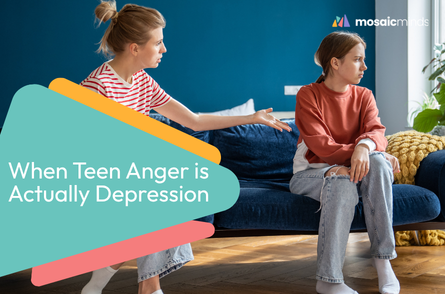
Mental health does not just affect a teen’s mood. It reroutes how they function everywhere at once: grades slip or spike in strange ways, sleep and appetite shift, friendships thin out, and a lot of what looks like attitude is actually a symptom nobody named yet.
At Mosaic Minds, this is the pattern we look for first, before a diagnosis, before a label: what changed, and where. Here’s how mental health actually shows up in a teen’s daily life.
The Behavior You’re Seeing Might Be a Symptom
NIMH lists persistent irritability and anger among the recognized symptoms of depression in teens, not just low mood. That matters because irritability gets punished. Sadness gets comforted.
A teen who is short-tempered, slamming doors, or picking fights over nothing is often read as disrespectful when the more accurate read is dysregulated.
| What It Looks Like | What Might Actually Be Going On |
| “He’s just lazy about homework” | Concentration and motivation are early casualties of anxiety or depression |
| “She’s so moody lately” | Irritability, not sadness, is one of the most common teen depression symptoms |
| “He’s being antisocial” | Withdrawal from friends is a common, quiet symptom, not a phase |
| “She’s overreacting to everything” | Sensory or emotional overload, especially in neurodivergent teens |
| “He’s always making excuses to skip school” | Anxiety often shows up as physical complaints or avoidance, not stated fear |
This is the gap that costs the most time. Parents wait for a teen to look sad enough to justify a conversation about mental health, and a teen whose main symptom is anger never looks sad.

How Mental Health Actually Shows Up
At School
The instinct is to assume better grades will lift a struggling teen’s mood, or that a slipping mood is what’s tanking the grades.
A 2024 study in Pediatric Research followed adolescents over time and found the relationship runs mostly one direction: strong academic performance predicted better mental health later on, but improved mental health did not reliably predict better grades afterward. A teen’s grades can be the first visible casualty of a mental health struggle. Fixing the grades alone won’t fix what’s underneath them.
In the Body
Mental health struggles in teens aren’t only emotional. Watch for:
- Sleep disrupted in either direction, too little or too much
- Appetite shifts, eating noticeably more or less than usual
- Headaches or stomachaches with no clear physical cause
- Constant fatigue that rest doesn’t seem to fix
- Getting “sick” more often, in ways that don’t fully resolve
A teen showing several of these is often communicating something their words haven’t caught up to yet.
In Friendships and at Home
Withdrawal is one of the more visible signs, but it rarely looks like a teen announcing they’re pulling away. It looks like fewer plans, shorter answers, a bedroom door that stays closed longer than it used to.
At home, the same struggle can look like more conflict, not less, because home is often the only place a teen feels safe enough to let the mask slip.
For Neurodivergent Teens
For a teen who is autistic, has ADHD, or is otherwise neurodivergent, a full day of masking, consciously managing eye contact, suppressing stimming, forcing themselves through sensory overload just to get through class, often leaves nothing left for the version of themselves that shows up at home.
What looks like an attitude problem at 4 pm is frequently the crash after a day spent holding it together somewhere else. That’s why our approach at Mosaic Minds is built around how a specific teen communicates and regulates, not a generic script.
If You’re a Teen Reading This
If you’ve been told you’re “too sensitive” or “too much,” or that you need to “just try harder,” and none of that matches what’s actually going on inside your head, you’re not broken and you’re not making it up.
A lot of what gets labeled as attitude is your body and brain telling you something is overloaded. That’s worth taking seriously, including by you.

What Actually Helps
The first step is rarely a diagnosis. It’s a conversation that treats the behavior as information, not a discipline problem.
Our free consultation call is where a specific pattern like the ones above gets talked through before anything is decided. If you want to know what an actual first therapy session looks like after that call, we cover that separately.
Call 480-916-9600 if any of this sounds like your teen.
Frequently Asked Questions
Yes, often before anyone notices anything else. Concentration, motivation, and memory are some of the first things affected by anxiety or depression, so a grade drop can be an early signal rather than the root problem. Fixing the grades alone rarely fixes what’s underneath them.
Often, yes. Withdrawal is common: fewer plans, shorter replies, less interest in things they used to enjoy. It’s rarely announced. It usually shows up as a slow fade rather than a dramatic pulling away, which is part of why it gets missed.
Yes. Sleep and appetite changes, frequent headaches or stomachaches with no clear medical cause, and constant fatigue are common physical signs of an underlying mental health struggle in teens, not just an emotional one. The body often reports the problem before a teen has words for it.
Some moodiness is developmentally normal. What’s worth a conversation is a change: a teen who was previously fine and is now consistently irritable, withdrawn, or checked out for more than a couple of weeks, especially if it’s affecting school or relationships.
For autistic or ADHD teens, a day spent masking, consciously managing behavior to get through school, often leaves little capacity left at home. What looks like an attitude problem in the evening can be the aftermath of holding it together all day somewhere else.